
A business rebrand works when it solves a real business problem and carries your search visibility, reviews and customer trust across to the new identity. It fails when it is treated as a new logo and nothing else. The visual work is the smaller part of the job. The bigger part is the plan underneath it: what you stand for, who you serve, and how every listing, page and profile that carries your name gets updated without losing the rankings you have built. At The DM Link, we build that plan and the website, search and reputation work in one place, so the new brand shows up the same way everywhere a customer might find you.
This guide is for owners of local businesses (restaurants, trades, home services, salons, brokers, consultants, architects) and the managers who work with them.
TL;DR
- Rebrand to fix a real problem (a changed business, a new audience, a name that no longer fits), not because the logo feels tired. A visual refresh is often enough.
- Work in this order: research, positioning, name and identity, messaging, then rollout. Design comes after the thinking, not before.
- The biggest hidden risk is lost visibility: a changed domain, broken links and a Google Business Profile that no longer matches. Plan the redirects and listings before launch day.
- Budget by scope. Canadian cost guides span from a few thousand dollars for a DIY job to well over $70,000 for a full audit and overhaul.
- Own everything you pay for: domain, website, content, accounts and data.
Table of Contents
- What business rebranding actually means
- When a rebrand is worth it, and when it isn’t
- The steps of a business rebrand, from research to launch
- Protecting your local search visibility during a rebrand
- What a rebrand costs in Canada
- What good rebranding support includes
- Perspective
- Where The DM Link fits
- A short rebrand checklist
- FAQ
- Sources
What business rebranding actually means
Your brand is the sum of what customers see and what they expect: your name, logo, colours, tone of voice, the way you answer the phone, and the reputation attached to all of it. Rebranding means changing some or all of that on purpose.
It helps to separate two levels of change:
- A brand refresh modernizes how you look and sound while the core identity and strategy stay the same. Think updated logo, cleaner colours, a rewritten website. HubSpot’s explanation of refresh versus rebrand puts the line there: a refresh keeps the strategy, a rebrand rethinks positioning, values and mission.
- A full rebrand changes the foundation: often a new name, a new target customer or a new way of positioning the business.
Most small businesses need the first and think they need the second. A plumber with a strong reputation and a dated truck logo needs a refresh. A consultancy that has moved from bookkeeping to business advisory, and whose name still says “Smith Bookkeeping”, needs a rebrand.
When a rebrand is worth it, and when it isn’t
The common thread in small business guidance is that a rebrand should answer a business problem. Target Accelerators lists the usual triggers: your offerings or markets have changed, the mission has changed, your audience has shifted, you have outgrown your image, or you need to stand apart from competitors.
In practice, these are the situations where we see a rebrand pay off:
- The business changed and the name didn’t. You added services, moved up-market or opened in a new region, and the name now describes something you no longer are.
- A merger, a partnership or new ownership means two identities need to become one.
- A name or domain problem, such as a trademark conflict or a name customers constantly misspell.
- Inconsistent visuals. Your signs, website, social profiles and invoices look like they belong to four different companies.
- Reputation baggage. A past issue is tied to the name and you want a clean start.
And these are the situations where a rebrand is probably the wrong tool:
- Sales dipped but customers still know and like you. The cause is more likely visibility, reviews or your website than your identity. A marketing fix will do more than a new logo.
- You are bored of the design. That is a refresh at most.
- You want a quick lift in leads. A rebrand is a project with a return measured over months, and it resets some things before it improves them.
A useful test: write down in two sentences what the rebrand must achieve, in numbers if you can (more booked calls, higher average job value, entry into a new city). If you can’t, you are not ready to brief anyone.
The steps of a business rebrand, from research to launch
The order matters. Most rebrands that disappoint started with design and discovered the strategy halfway through.
1. Audit what you have
List every place your brand lives: website, Google Business Profile, social accounts, directory listings, email signatures, invoices, vehicles, signage, uniforms, packaging, contracts and printed material. Then note what customers actually say about you in reviews. This tells you which parts of the brand carry equity worth keeping.
The common mistake is auditing only the visual assets. Your search visibility and your reviews are brand assets too, and they are the hardest to rebuild.
2. Set the goal and the baseline
Before anything changes, record where you stand: monthly calls and form leads, Google Business Profile views, organic traffic, review count and average rating. Shopify’s rebranding guide recommends setting SMART goals with measurable KPIs and baselines before launch. Without the baseline you can’t tell whether the rebrand worked.
3. Research your customers and competitors
Talk to ten recent customers. Ask why they chose you and what they would tell a friend. Then look at how the three or four businesses that win your local searches present themselves. You are looking for the gap: what customers want that nobody in your market says clearly.
Our approach here is to build around your market, your competitors and your seasons, not a template. A snow-removal company and a patio-builder in the same city have opposite busy seasons, and the brand rollout should respect that.
4. Define positioning and messaging
Decide who you serve, what you do better than the alternatives, and the three or four things you want customers to say about you. Write the message before the design. If you serve both English and French customers, as many Canadian businesses do, write both versions properly from the start rather than translating at the end. French copy that reads like a translation costs you trust in Quebec.
5. Decide: keep the name or change it
Changing your name is the highest-risk decision in the project. If your name is already known locally and ranks well, evolving the logo and messaging while keeping the name preserves most of your equity. If you do change it, you will need to handle legal registration (more on that below), a new domain or redirects, and every listing.
6. Design the identity
Only now do logo, colours, typography, photography style and a short guideline document come in. A good guideline is two or three pages, not a 60-page manual: how the logo is used, the colour codes, the fonts, the tone of voice. Anyone you hire later (a sign maker, a print shop, a new hire) should be able to follow it.
7. Rebuild the website and digital presence
Your website is where the new brand meets search. This is where rebrands most often lose visitors, because a redesign without a redirect plan can wipe out years of ranking. If the site needs more than a new logo, our guide to what drives website redesign cost in Canada explains how scope changes the price.
8. Roll out in a planned order
Tell people before they see it. Announce to existing customers by email and on social media, explain why you are changing and what stays the same (your team, your service, your phone number if it hasn’t changed), and then switch the public-facing assets together. A half-switched brand, with a new website and old signs and old listings, confuses customers more than either version alone.
9. Measure and adjust
Check your baseline metrics weekly for the first two months, then monthly. Expect some movement in search while Google processes the changes, and fix broken links and mismatched listings as they appear.
Protecting your local search visibility during a rebrand
For a local business, this is the section that decides whether the rebrand costs you leads. Rankings in Google’s local results and in standard search are built over years, and a careless change can reset them.
Your Google Business Profile
Google’s Business Profile guidelines say a profile can be rebranded without creating a new one only when the proper nouns and services in the name, and the business category, stay the same (or for multi-location businesses). Otherwise Google treats it as a new business, and the old profile must be marked closed and a new one created. A new profile starts without the reviews and history of the old one.
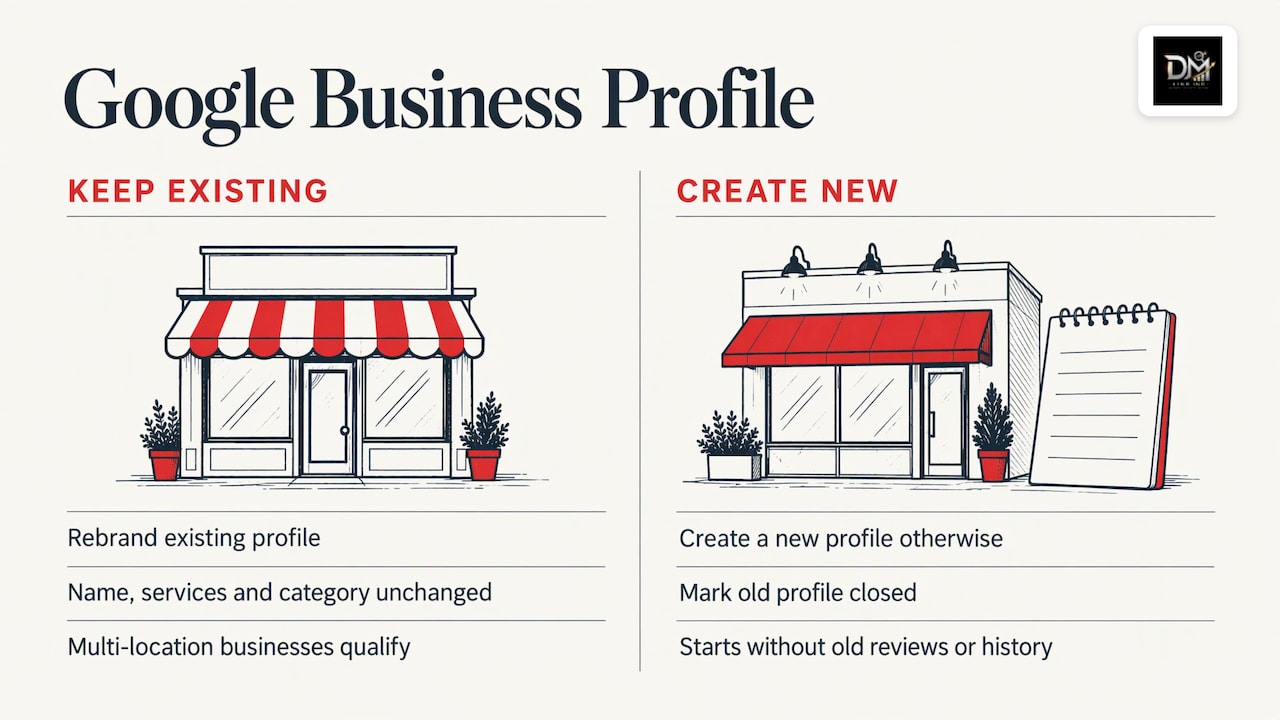
That is a strong reason to think hard before changing a name that carries your reviews. If you do need a new profile, plan how you will ask happy customers for new reviews. Our Google review management guide covers how to do that steadily and within the platform’s rules.
Your website and domain
If the web address changes, Google’s site move documentation sets out the process:
- Map every old URL to its new equivalent before launch.
- Use permanent server-side redirects (301 or 308) from old to new addresses.
- Avoid redirect chains, ideally no more than three hops.
- For a domain change, submit a Change of Address in Search Console and the new sitemap.
- Keep the redirects in place for at least a year.
Shopify’s guide warns that name and domain changes carry technical risks, including lost search traffic, broken backlinks and pages that stop working. All of these are avoidable with a redirect map and a checklist, but they are very hard to repair after launch. This is also why we insist you own your domain, hosting, site and accounts from day one: you can’t control a migration on assets you don’t hold.
Listings, directories and mentions
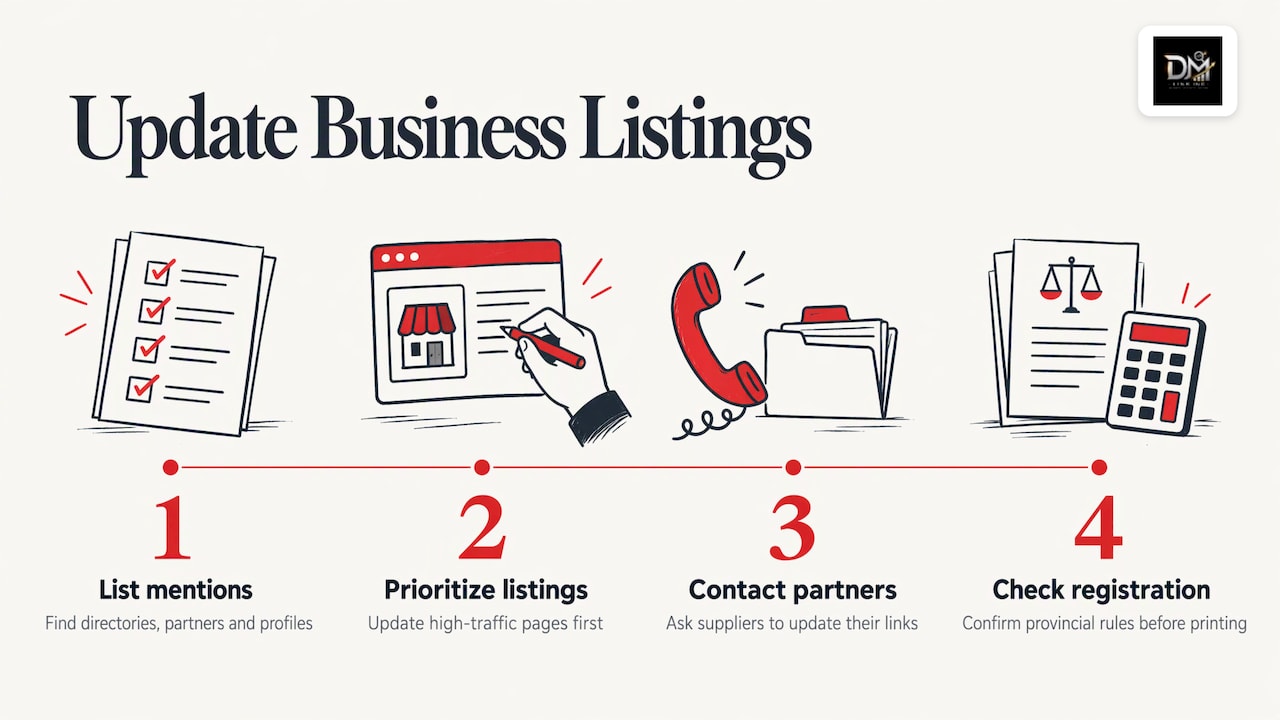
Your name, address and phone number appear in dozens of places: directories, chamber of commerce pages, supplier sites, social profiles, your own email signature. Inconsistent versions weaken trust with customers and with search engines. Make a list, update the high-traffic ones first, and ask partners and suppliers who link to you to update their pages. If your legal name is changing, this step-by-step guide to changing a corporation name in Canada covers the registration side so your listings match the official record.
If you only change the operating name you trade under, the Canada Revenue Agency lets businesses change a business operating name online. The same page notes that a change of legal entity type is treated as a new business needing a new business number. Check with your accountant or lawyer for your province’s own registration rules before you print anything.
Your reputation
Monitor what customers say in the weeks after launch. Confusion shows up in reviews and messages first: “is this the same company?” Answer quickly and consistently. Our guide to brand reputation monitoring explains what to track and how to respond.
What a rebrand costs in Canada
There is no single price, because scope varies so much. Shopify Canada’s 2026 rebrand cost guide (May 2026) puts branding costs anywhere from a few thousand dollars for a DIY approach with design tools or freelancers to over $70,000 for a full brand audit and comprehensive package. The same guide notes that a refresh typically takes weeks, while a full overhaul takes at least several months, with cost rising along with the back-and-forth.
The cost drivers are consistent:
- Scope: logo only, full identity, or identity plus strategy and website.
- Name change: adds legal, domain, listing and signage work.
- Website: a new site or a migration is often the largest line item.
- Physical assets: signage, vehicle wraps, uniforms, packaging, printed material.
- Languages: a bilingual rollout means two sets of copy.
- Timeline: compressed schedules cost more.
Two things keep a budget honest. First, map your customer journey before you commission anything. Shopify’s guide suggests this so the rebrand stays consistent across channels: if customers find you on social media and land on a mismatched website, they leave, and if email brings in more revenue than social, the email templates need updating too. Second, ask for a fixed scope in writing, with the deliverables listed, so you know what is and isn’t included.
We don’t publish prices for our services, because the right scope depends on your business. A short conversation about what needs to change is the fastest way to a realistic number.
What good rebranding support includes
When you look at business rebranding services, the difference lies less in the logo and more in what surrounds it. A complete engagement covers:
- Strategy and positioning, before design.
- Logo and visual identity, with usable guidelines.
- A website that carries the new brand and keeps your search equity.
- Local search and listings work, so the new name appears correctly everywhere.
- Review and reputation handling through the transition.
- Applications of the brand: social media, email templates, signage, custom merchandise.
The usual frustration with agencies is fragmentation: one firm designs the logo, another builds the site, a third “does SEO”, and nobody owns the gaps between them. The redirect map falls between the designer and the developer. The listings fall between everyone. That is where visibility leaks.
Our professional branding services and website design and digital marketing work are built to sit under one plan for exactly this reason.
Perspective
Most rebrands we are asked about start with a logo request and turn out to be a visibility problem. The owner’s phone is not ringing as much as it should, and the brand looks like the obvious culprit. Sometimes it is. More often the business has weak local authority: thin reviews, a site that doesn’t answer what customers ask, listings that disagree with each other.
That is why we build brand, website, search and reputation as one piece of infrastructure rather than four separate jobs. A new identity should make you easier to find and easier to choose, and it should never cost you the rankings you already own.
You talk directly to the people doing the work, not to an account manager. Everything is built in-house on one plan, in English and French, written like a local. And you own it all, from day one: domain, hosting, site, content, accounts and data. If you ever want to change course, nothing is held hostage.
Our advice: rebrand to move forward, keep what customers already trust, and put the plan for search and reviews on the table before the first design is drawn.
DM
Where The DM Link fits
If you are weighing a rebrand and want to know what it should cover, we can look at your visibility first. Our free Leak-Proof Audit™ evaluates your local authority and points to where visibility and revenue are being lost, which tells you whether you need a full rebrand, a refresh or a fix elsewhere. From there, we handle logo and brand design, website, local SEO, reputation and reviews, and branded merchandise under one plan.
See what we offer or start from our home page to book your audit.
A short rebrand checklist
- Two-sentence goal written down, with the metrics you will track.
- Baseline numbers recorded: leads, calls, traffic, reviews, Google profile views.
- Customer interviews and competitor review done.
- Positioning and messaging written before design starts.
- Decision on name made with the Google Business Profile rules in mind.
- Redirect map and listing update list prepared.
- Customers, staff and partners told before the public switch.
- Domain, hosting, accounts and files in your own name.
- Review and reputation monitoring running from launch day.
FAQ
How long does a small business rebrand take?
It depends on scope. A refresh of the logo and website generally takes weeks, while a full rebrand with new positioning and name takes several months, according to Shopify Canada’s cost guide. Add time if signage, vehicles or printed material need replacing.
Is rebranding risky for a local business?
The risks are mostly about visibility and clarity: a profile on Google that has to be recreated, a domain move that loses links, customers who don’t recognize you. Each has a fix when planned in advance, including redirects, consistent listings and a clear announcement. A rebrand that keeps your recognizable elements and explains the change carries much less risk than an abrupt overhaul.
Do I need to change my business name to rebrand?
No. Many rebrands keep the name and change the look, messaging and website. Keeping the name preserves your reviews, links and local recognition. Change it only when it no longer fits what you do or when there is a legal reason.
What should I do first if I’m considering a rebrand?
Record your current numbers and write down the problem you want to solve. Then have your local visibility reviewed so you know whether identity is the cause. Our free Leak-Proof Aud™ is built for that first step.
Sources
- Brand Refresh vs Rebrand, HubSpot
- When to Rebrand for Small Businesses, Target Accelerators
- Rebranding Guide, Shopify
- How Much Does a Rebrand Cost?, Shopify Canada
- Guidelines for representing your business on Google, Google Business Profile Help
- Site Moves and Migrations, Google Search Central
- Making changes to your business, Canada Revenue Agency