Answer engine optimization (AEO) is the work of making your business easy for AI tools to find, understand and name when someone asks them a question. Instead of a list of ten blue links, the person gets one written answer, and a few sources are cited inside it. AEO is about being one of those sources. For a local business, that means your site, your Google Business Profile and your reviews all have to tell the same clear story. We build that foundation as one plan at The DM Link, and this guide shows you how it works so you can judge it for yourself.
TL;DR
- AEO is optimizing so AI tools such as Google’s AI Overviews, ChatGPT and Perplexity can retrieve, lift out and cite your content in their answers.
- It builds on SEO rather than replacing it: Google says optimizing for its AI features is still SEO.
- For local businesses, the basics decide most of it: a complete business profile, a fast and clear website, consistent listings and real reviews.
- Content that answers a question in the first sentence, then backs it up with specifics, is easier for an AI tool to quote.
- Measure it by testing real questions on a schedule and watching referral traffic, not by waiting for a single ranking report.
Table of Contents
- What answer engine optimization actually is
- How AEO differs from SEO, and why SEO still matters
- Why local businesses should care
- How an answer engine picks what to cite
- What to do about it: a practical sequence
- A short example
- How to measure AEO, and what to keep in mind
- Perspective
- Where to start with us
- FAQ
- Sources
What answer engine optimization actually is
An answer engine is any tool that responds to a question with a written answer rather than a results page. Google’s AI Overviews and AI Mode, ChatGPT, Perplexity and Microsoft Copilot all work this way. Behind the scenes, they find candidate pages, pull out the passages that fit the question, write a response and attach links to the sources.
PwC describes AEO as making content easy for AI to find, understand and reuse, noting that these systems combine information from several sources rather than handing over a ranked list. That gives you three practical jobs:
- Be reachable. The page can be crawled and is in the index the tool draws from.
- Be liftable. A paragraph still makes sense when it is pulled out of the page and read alone.
- Be quotable. The claim is specific enough that a tool can restate it and point back to you.
You may also see the terms GEO (generative engine optimization) and AI SEO. For a business owner, they describe the same goal: being named in the answer.
How AEO differs from SEO, and why SEO still matters
Traditional SEO ranks whole pages for a search. An answer engine works from passages and blends several sources into one reply. Your page can rank well and still be missing from the answer if the key fact is buried in a long paragraph, vague, or unsupported.
That does not mean SEO is finished. Google’s own documentation says that optimizing for its generative AI features is still SEO. Pages must be indexed and eligible to appear with a snippet to be used in those features. The same point shows up in traffic data: Shopify’s 2026 write-up of BrightEdge research reports that Google still sent 87.6% of organic search traffic to ecommerce brand sites in November 2025, against under 1% from AI engines. Search is still where most visits start, and the same foundation feeds both.
We have written about this in more depth in why SEO is still essential even with AEO and GEO emerging. The short version for a business owner:
| Classic SEO | AEO | |
|---|---|---|
| What is judged | The whole page and the site | A passage, and whether it can be trusted |
| What the searcher sees | A list of links | One written answer with a few sources |
| What wins | Relevance, authority, a good experience | A clear, specific answer from a source the tool trusts |
| What you want | A click | A mention, a citation, then a call or a booking |
The two share the same raw material, which is why treating them as separate projects, with separate vendors, tends to leave gaps.
Why local businesses should care
When someone asks an AI tool for “a good plumber near me”, “a salon that does balayage in Laval” or “an architect who handles heritage renovations”, the tool has to decide who to name. It does not have a lot of room. Fewer businesses get named than appear in a map pack, so a clear, consistent profile counts for more.
The sources these tools lean on for local questions are the ones you already control or influence: your website, your Google Business Profile, review sites and directories. If your hours differ between Google and your site, if an old directory lists a former address, or if your services page says “we offer a wide range of solutions” without naming a single service, a tool has little to quote and plenty of reason to pick someone clearer.
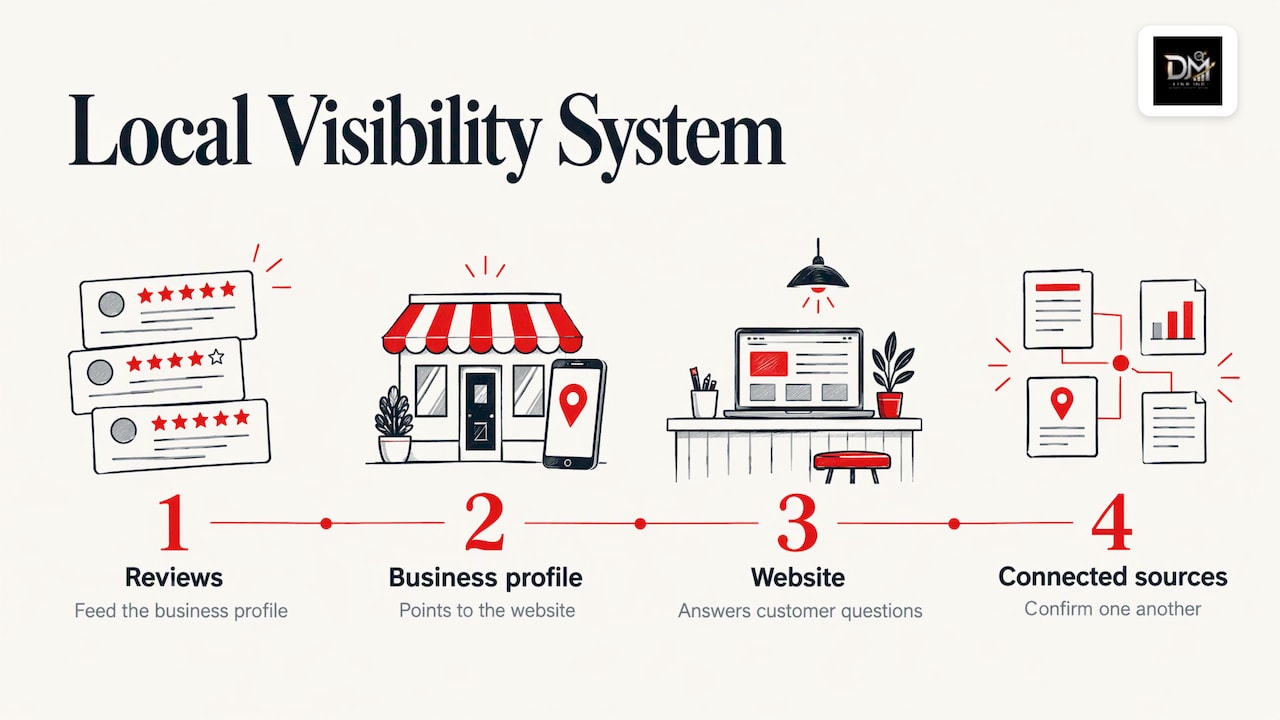
This is why we treat local visibility as one system. Reviews feed your profile, the profile points to your site, your site answers the questions customers ask, and each piece confirms the others. Our guide to how reviews affect local SEO and Google Business Profile rankings covers the review side in detail.
How an answer engine picks what to cite
No tool publishes its full recipe, but the pattern is consistent enough to plan around. Google describes its AI features as using retrieval from the index and a technique called query fan-out, where one question is split into several related searches to gather supporting pages. In practice, that means a tool does not just look for your exact phrase. It looks for pages that answer the related questions around it.
From there, a few things make a source easier to choose:
- A direct answer near the top of the section. If the question is “how much notice do you need for a furnace repair”, the first sentence under that heading should answer it.
- Specifics over claims. “We serve Gatineau, Hull and Aylmer, with same-day calls before noon” is quotable. “We serve the whole region quickly” is not.
- Trust signals the tool can verify. Consistent name, address and phone number across listings, real reviews, and a site that loads and works on a phone.
- Structure. Clear headings, short paragraphs, and structured data (code that labels your business details, FAQs and services so machines can read them without guessing).
AI-generated answers are not always built from the page they cite. A 2024 academic study, Wallat et al., looked at how often citations are added after the model has already formed its answer. This is one more reason to be specific and consistent: you want to be the source that matches the facts, not a page that is merely nearby.
What to do about it: a practical sequence
For a local business, AEO does not start with a new tool. It starts with tidying the evidence about your business. Here is the order we would work through.
1. Fix the facts everywhere
Check your business name, address, phone number, hours, categories and website address on your Google Business Profile, your site, Apple Business, Bing Places and the directories that matter in your trade. Fix any listing that points to an old domain. Inconsistent details are the easiest problem to fix and one of the costliest to ignore.
2. Make sure crawlers can reach you
Confirm your site is indexed, loads over HTTPS, has a sitemap, and is not blocking search crawlers in its robots.txt file (the small file that tells crawlers which pages they may visit). Google notes that pages need to be eligible to be shown with a snippet to appear as supporting links in its AI features, so check that no setting is quietly switching that off.
3. Write each page to answer one question
Take your top ten customer questions: price ranges, timelines, service areas, what is included, what to prepare. Give each its own heading and a first sentence that answers it, then add the detail: numbers, examples, steps. A restaurant can answer “Do you take large group bookings?” with capacity and notice. A trades business can say which postal codes it covers and what an emergency call involves.
4. Add structured data
Mark up your business details, services and FAQs so machines read them directly. HubSpot’s guide to AEO notes that FAQ, How-To and Article schema send explicit signals about what a page contains. Mark up only what is visibly on the page.
5. Build reviews that say something
Reviews that mention the service, the neighbourhood and the outcome give a tool more to work with than a row of five-star ratings with no text. A steady flow of recent reviews, answered promptly, supports both your map ranking and how you are described. Our Google review management guide walks through the routine.
6. Use formats that can be read as text
Video can help your visibility when it comes with transcripts, captions and a clear script, because those give AI systems text to work from. This B2B video marketing guide shows how scripts and captions shape content that is easy to extract and reuse.
7. Keep it fresh and signed
Show who wrote or reviewed a page and when it was last updated. A page about pricing or service areas that has not been touched in three years is a weak source, for people and machines alike.
A short example
Take a fictional renovation contractor in Ottawa. Before: the services page says “Quality renovations for every budget,” the Google profile lists a former phone number, and two directories show the old website address. After: each service has its own page that opens with a direct answer (“A basement finishing project in Ottawa typically takes six to ten weeks, depending on permits”), the profile and directories match, and each completed job generates a review that names the neighbourhood. Nothing exotic has been added. The business has simply become easier to describe correctly.
How to measure AEO, and what to keep in mind
Measurement is the hardest part, and it is better to be honest about it. Google says that clicks from its AI features are counted in the Performance report under the Web search type in Search Console, and recommends tracking conversions and time on site in a tool such as Google Analytics. That is a start, but it does not tell you which prompts triggered a mention.
A workable routine for a small business:
- Build a prompt list. Write 20 questions your customers actually ask, including the “near me” and comparison types.
- Test monthly. Run them in Google, ChatGPT, Perplexity and Copilot, and log whether you are named, how you are described, and which sources appear.
- Track referrals. In your analytics, watch visits from AI tools and, more importantly, booked calls, form submissions and direction requests.
- Compare over time. Answers vary from one run to the next, so look for a trend across months, not a single result.
Keep the limits in mind: AI answers change often, they differ by tool and by wording, and public data specific to Canadian local businesses is still thin. Treat AEO as steady improvement in how clearly you are described, with the booked call as the number that counts.
Perspective
Most local businesses we talk to are not short of effort. They have a website from one provider, ads from another, a profile nobody has opened in a year and reviews nobody answers. Each piece is fine alone. Together they contradict each other, and that is exactly what an answer engine punishes.
Our view is that AEO is what happens when the whole system is coherent. We build SEO, web design, digital marketing and reputation management as one plan, in-house, so the name on your listing matches the name on your site, the question your customer asks is answered on a page built for it, and the review that mentions your service is sitting where it can be found.
We also think you should own what we build: your domain, hosting, site, content, accounts and data, from day one. Visibility you own keeps working. Visibility you rent from ads stops the day the budget does. You talk to the people doing the work, in English and in French, written like a local.
DM
DM
Where to start with us
If you want to see where your business is losing visibility before you change anything, our free Leak-Proof Audit™ evaluates your local authority and points to where visibility and revenue are slipping away. From there, our AI and answer engine SEO services cover the work described above, built on your market, your competitors and your seasons.
You can talk directly to the team doing the work, with no account manager in between. Start on our main page or read how we approach local lead generation that lasts.
FAQ
What is answer engine optimization in simple terms?
It is the practice of structuring your website and online listings so AI tools can find your information, understand it and cite it when they answer a question. The aim is to be named in the answer, not just listed in the results.
Is SEO still relevant if people use AI tools?
Yes. Google’s own documentation says optimizing for its AI features is still SEO, and pages need to be indexed and eligible for snippets to appear in them. Most of what helps in AEO, such as clear content, technical health and trust signals, comes from good SEO.
How does answer engine optimization work for a local business?
It works by making your facts consistent and your content specific. Your Google Business Profile, website, directories and reviews should all agree, and each service page should answer real customer questions directly, so a tool has something clear to quote.
How long does it take to see results?
There is no fixed timeline, because answers vary by tool, wording and the strength of your existing profile. Cleaning up listings and rewriting key pages is quick to do. Track a monthly prompt log and your booked calls to see the trend over several months.
Sources
- Google Search Central: Optimizing for generative AI features
- Google Search Central: AI features and your website
- PwC: What is Answer Engine Optimisation?
- Shopify: AEO vs. SEO
- HubSpot: What is answer engine optimization
- Wallat et al. (2024), arXiv:2412.18004
- B2B Video Marketing: A Practical Guide