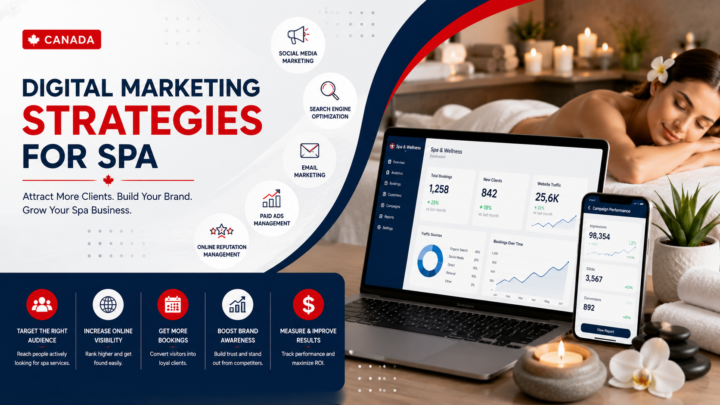

An outsourced marketing team is a group of specialists outside your company who run your marketing as if they were your own department: search visibility, website, reviews, social and paid campaigns. For a small business, the best version is one team that handles all of it together, answers to you directly and leaves you owning every asset it builds. That is how visibility becomes something you own instead of something you rent through ads each month.
TL;DR
- An outsourced marketing team (also called an outsourced marketing department) covers strategy, search, web, content, reviews and reporting without a full-time payroll.
- It suits owners who need steady local visibility but cannot staff a strategist, a developer, a writer and an SEO specialist.
- The value comes from one coordinated team, direct access to the people doing the work, and full ownership of your domain, hosting and data.
- Set a baseline and measure in three layers: work delivered, search progress, and business outcomes such as qualified calls.
- Price depends on scope, competition and how much you need built before results can compound.
Table of Contents
- What an outsourced marketing team is
- What an outsourced team can handle
- Outsourced team, in-house hire or traditional agency
- When outsourcing makes sense
- What it costs and what moves the price
- How to work with an outsourced team
- Our perspective
- Where to start
- FAQ
- Sources
What an outsourced marketing team is
The phrase covers a simple arrangement: you contract an outside team to carry out marketing work that would otherwise need several hires. You keep the decisions that belong to you (budget, offers, brand priorities). The team plans, builds, publishes, monitors and reports.
People also search for “outsourced marketing services” and “outsourced marketing department.” The first usually means buying individual services, such as a website build or a month of SEO. The second means a standing team that behaves like a department: it has a plan, a calendar, a reporting rhythm and a single point of accountability. Most small businesses get more from the second, because search, website, reviews and ads depend on each other.
A local plumber, a dental clinic, a restaurant and a travel operator all have the same underlying problem. Customers search, compare a few results and call the one that looks credible. Winning that moment needs a site that loads and converts, a well-kept Google Business Profile, steady reviews, and pages that match what people type. Those jobs sit with different specialists, which is why one hire rarely covers them.
What an outsourced team can handle
Scope varies, but the work usually falls into these groups:
| Area | What the work looks like |
|---|---|
| Local and organic search (SEO) | Keyword research, page optimization, local listings, technical fixes, content |
| Website design | Building or rebuilding a site that loads fast, reads well on a phone and turns visits into calls or forms |
| Answer engine optimization | Making your business easy for AI assistants and search summaries to understand and cite |
| Reputation and reviews | Requesting reviews, responding to them, monitoring brand mentions |
| Paid ads and social | Campaigns and social content that support the organic work |
| Branding and design | Logo, visual identity, printed and merchandise items |
| Reporting | Tracking calls, forms, bookings and what produced them |
You do not need all of it at once. A common sequence is to fix the foundation first (site, profile, listings), then add content and reviews, then add paid channels where the data shows a return. Our services page shows how these pieces fit together under one team.
Outsourced team, in-house hire or traditional agency
There are three ways to get marketing done, and each fits a different situation.
One in-house marketer. You get someone who knows your business daily, but one person is rarely a strong SEO specialist, designer, developer and copywriter at once. You pay salary whether the month is busy or quiet, and if that person leaves, the knowledge leaves too.
A traditional agency. Many agencies sell separate services from separate teams, and you talk to an account manager who relays your message. The frustration owners describe is familiar: the website team and the SEO team do not talk, reports list activity instead of leads, and nobody can say what you actually own.
An outsourced team built as one unit. You speak directly to the people doing the work, the services are coordinated around one plan, and the assets (domain, hosting, data) are yours. At The DM Link, clients speak directly to the team doing the work rather than an account manager, delivery is in-house, and you fully own your domain, hosting and data.
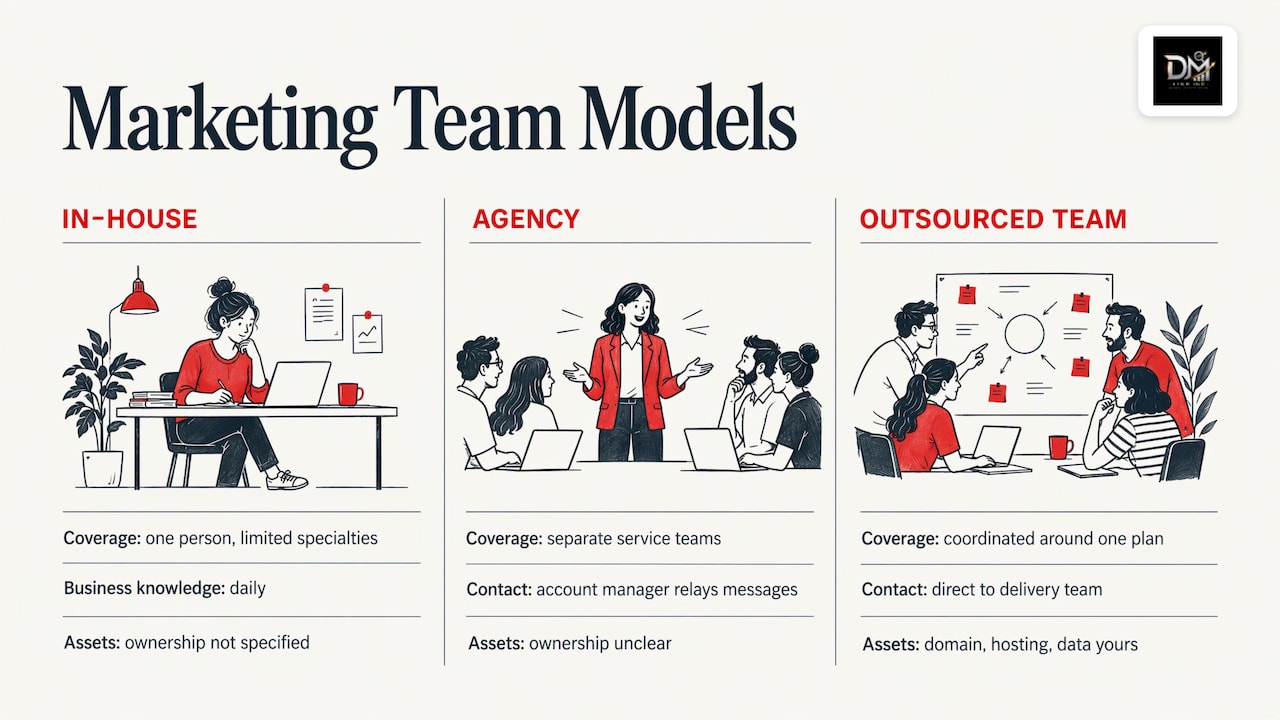
The last point matters more than it sounds. If your site, tracking and listings live in accounts you control, your visibility keeps compounding even if you later change providers or bring marketing in-house.
When outsourcing makes sense
The model fits when one or more of these is true:
- You are the owner and marketing is one of six jobs you are doing badly on Sunday nights.
- Your calls and enquiries depend on ads, and when the budget stops, the leads stop.
- You have a website but it does not rank, or it ranks and does not convert.
- Your reviews are sparse or uneven compared with competitors nearby.
- You serve customers in both English and French, or plan to. A team that writes both languages natively avoids the stiff translations that put off local searchers. Our page on local SEO for small businesses in Quebec shows what that looks like in practice.
- You already have a marketing manager but lack technical, design or search capacity. An outside team complements the manager instead of replacing them.
If you are a restaurant, a search-friendly website is often the first job. For trades, the starting point is usually local SEO for home service businesses.
What it costs and what moves the price
Outsourced marketing is typically sold as a project (a website build, a brand identity) or as a monthly retainer (ongoing search, content, reviews, ads management). We do not publish fixed prices because the right scope depends on your business, so any number you find in a generic guide should be treated as a rough range, not a quote.
These are the factors that actually change the price:
- Scope. One service costs less than a coordinated programme across search, web, reviews and ads.
- Starting point. A site that needs rebuilding or a profile with listing errors needs foundation work before growth work.
- Competition. Ranking for a term in a dense metro market takes more effort than in a smaller one.
- Service area. One location, several locations or national coverage change the volume of pages and profiles.
- Languages. Bilingual content roughly doubles the writing and review work.
- Ad spend. Ad budget goes to the platforms and is separate from the management fee.
Compare options on what they include and what you own at the end, not just the monthly figure. Ask what you would hold if the engagement stopped: the site, the domain, the analytics, the profiles. For a first read on where your money is leaking, the free Leak-Proof Audit™ evaluates your local authority and points to where visibility and revenue are lost.
How to work with an outsourced team
A good engagement is a rhythm, not a hand-off. Here is a routine that works for owners with little time.
1. Write down what a good lead is
Decide what counts: a phone call over a minute, a quote request, a booking. Name the services and areas you most want. The team can only aim at a target you have defined.
2. Record a baseline before work starts
Capture current rankings, calls, form submissions, review count and rating, and website speed and availability. The SMB Hub recommends documenting the baseline before work begins so neither side argues from anecdotes later. For the website, an uptime monitoring setup can log availability and incidents from day one.
3. Agree a single point of contact and a cadence
One monthly review and one short channel for questions is enough for most small businesses. You should be able to ask the person who made a change why they made it.
4. Measure in three layers
The same guide suggests looking at an engagement in three layers:
- Delivery and quality: were the agreed changes completed and verified on the live site, and do pages and local profiles still work?
- Search progress: is the site crawlable, are impressions and average position improving for the topics you intended, and do local profiles appear for the right areas?
- Business outcomes: which pages produce qualified calls, forms, bookings or sales, and is lead quality changing?
The third layer is the one that pays your bills. Rankings are a means, not the result.
5. Check rankings the way customers see them
Search results differ by location and device, so one result page on your own laptop misleads. A guide to local rank tracking from different locations explains why a single view of the results can mislead you. Ask your team to report rankings for the neighbourhoods you serve, not a single spot.
6. Keep the assets in your name
Confirm that the domain registration, hosting, analytics and Google Business Profile are under your own accounts from the first week. This is standard practice at The DM Link, where you fully own your domain, hosting and data.
Our perspective
Most owners we talk to are not short of tactics. They are short of a system. They have paid for a website in one place, a few ads in another and a review request in a spreadsheet, and none of it adds up to steady calls.
We think of marketing as local growth infrastructure: search visibility, a site built to convert, a reputation that shows up when someone is deciding, and reporting that ties it to booked calls. Built together, each piece makes the others work harder.
That is why we keep delivery in-house and put you in direct contact with the team doing the work. Nobody has to translate your goals through a middleman, and what we build is yours. For businesses serving customers in English and French, our bilingual service means the content sounds like it was written locally, because it was.
Ads are fine for a launch, but when the budget pauses, so does the traffic. The assets you own keep working.
DM
Where to start
If you want a team that covers search, web, reviews and branding as one plan, begin with our digital marketing services. We start from your local authority: where you appear, where you are invisible, and where leads slip away. The Leak-Proof Audit™ is free and gives you that picture before you commit to anything.
If your concern is AI-generated answers and how your business shows up in them, see our AI and answer engine SEO services. To compare search with advertising for your situation, read our piece on local SEO versus Google Ads.
FAQ
What is the difference between outsourced marketing services and an outsourced marketing department?
Outsourced marketing services are individual tasks you buy, such as a website or monthly SEO. An outsourced marketing department is a standing team that plans, executes and reports across channels under one strategy. Small businesses usually get better results from the department model because the channels support each other.
Will an outsourced team replace my marketing manager?
Not necessarily. Many businesses use an outside team to add search, design and technical skills their manager does not have. The manager keeps ownership of brand and priorities, and the team handles execution and reporting.
How long before I see results?
Paid ads can send traffic quickly, but organic and local visibility builds over months as pages, profiles and reviews accumulate. Judge early progress on delivery and search progress, then on calls and bookings as the work matures. Your baseline is what lets you tell the difference.
What should I own at the end of the engagement?
You should own your domain, hosting, website, analytics and business profiles, with access under your own accounts. That way your visibility stays with your business regardless of who manages it. We build every project on that basis.
Sources
- How to Choose a Small Business SEO Company (2026), The SMB Hub
- Local rank tracking: why one search result page lies to you, Masklabs
- Uptime monitoring for agencies, Uptime Beacon