
Brand strategy services give a business a written plan for who it serves, what it stands for, how it sounds and why customers should pick it over the next name in the results. For a local business, the plan only pays off when it reaches the places customers actually meet you: your website, your Google listing, your reviews and your signage. The strongest results come when the strategy and the people who build those pieces sit on the same team. That is how we work at The DM Link: one team, one plan, and a brand you own from day one.
This guide is for owners and marketing managers of Canadian local businesses: restaurants, trades, home services, salons, brokers, consultants and architects. It explains what you are buying, what a good engagement looks like, how to tell whether it is working and how to decide who should do it.
TL;DR
- A brand strategy is the plan behind your branding: positioning, message, voice and look, decided before anything gets designed.
- It is different from a logo or a campaign. The strategy sets the direction, and the logo, website and ads carry it out.
- For a small local business, a strategy earns its keep when it shows up in search results, reviews and the website, not in a document that sits in a drawer.
- Measure it with a few plain signals: calls and bookings, branded searches, review quality and how consistently customers describe you.
- Hiring one team that plans and builds, in English and French where you need it, keeps the strategy from getting lost between suppliers.
Table of Contents
- What a brand strategy actually does
- Brand strategy, logo, identity and marketing: where the lines are
- What brand strategy services include
- How an agency builds a strategy with you
- Brand strategy for a small local business
- Worked example: a three-person plumbing company
- How to tell whether your brand strategy is working
- Hiring an agency or doing it yourself
- Where The DM Link fits
- Our perspective
- FAQ
- Sources
What a brand strategy actually does
A brand strategy is the formal plan underlying all of an organization’s branding efforts. NIQ describes it as the unifying force that informs decisions in sales and promotion, product development and distribution, and it is meant to create and maintain a brand’s position and build its value over time.
In plain terms, it answers a handful of questions that most owners have answers to in their heads but have never written down:
- Who is the ideal customer, and what are they actually trying to solve?
- What do you do better, or differently, than the three competitors a customer is likely to compare you with?
- What should someone think and feel after one visit to your website or one phone call?
- How do you talk: formal or relaxed, technical or plain, in English, in French, or both?
Coursera frames it as a framework that determines how a business presents itself and stands out among competitors, so it can reach its ideal customers and market its products more effectively. That is the practical benefit: every later decision, from the homepage headline to the reply you write to a review, has something to be checked against.
The benefit compounds for businesses working in a crowded market. NIQ notes that the value of a brand strategy is greatest when a business needs to distinguish itself and communicate what makes it unique in a way that builds long-term loyalty, such as repeat business and word-of-mouth referrals, rather than only lifting short-term sales. A dentist, a plumber or a boutique accounting firm in a mid-sized Canadian city is in exactly that position: many similar options, and customers who decide in minutes.
Brand strategy, logo, identity and marketing: where the lines are
Owners often ask for a logo when what they need is a direction. The pieces are related but distinct.
| Piece | The question it answers | Example for a local renovation company |
|---|---|---|
| Brand strategy | Why do we exist, for whom, and how do we want to be seen? | We serve homeowners who want fixed-scope renovations with no surprises |
| Brand identity | What do we look and sound like? | Logo, colours, type, photography style, tone of voice |
| Website and content | Where do people learn about us? | Service pages, project galleries, a clear quote request path |
| Marketing campaign | How do we get attention right now? | A spring ad push, a review request sequence |
The strategy comes first because it decides the rest. A logo designed without it is a guess about taste. A campaign run without it tends to say something different each month, and customers read that as a business that does not know itself.
What brand strategy services include
Packages vary, but the work usually breaks down into four building blocks. NIQ lists the core components of a brand strategy as brand value (your mission and what makes you different), brand design, brand story and brand voice. For a small business, that translates into deliverables you can hold in your hand:
- Market and competitor review. Who else shows up when your customers search, how they present themselves and where the gaps are.
- Positioning and value statement. One clear sentence on who you serve and why you are the better choice, plus the proof points behind it.
- Brand story and messaging. The narrative and the handful of key messages you repeat everywhere, adapted to your customers and your seasons.
- Voice and visual direction. How you write and speak, and the logo, colour and design rules that make everything look like it came from one business.
- An activation plan. Where the brand goes first: website, Google Business Profile, reviews, social, signage, uniforms, merchandise.
That last item separates a useful engagement from a slide deck. A strategy that stops at the document leaves you to translate it into a site, a listing and a logo through several other suppliers, and each handoff is a place where the message drifts.
How an agency builds a strategy with you
The sequence below is the one we recommend you expect from any provider, and it is how we think about the work at The DM Link.
1. Discovery
The provider asks about your customers, your best jobs, your worst jobs, your pricing and where your work comes from today. Bring real material: your top ten customers, your most profitable services, a few reviews you love and a few that sting. Strategy built on your own numbers is sharper than strategy built on a template.
2. Market and competitor analysis
This is where your local reality matters. A salon in Sherbrooke competes differently from a consulting firm in Calgary, and customers in different provinces search in different languages. A good analysis looks at your market, your direct competitors and your seasons: the weeks when demand spikes and the ones when it goes quiet.
3. Positioning workshop and decisions
Positioning is how a business stands out from competitors, and it forces choices. You cannot be the cheapest, the most premium and the fastest at once. This step ends with a short list of decisions you sign off on: the audience, the promise, the proof and the personality.
4. Messaging and identity
Once the positioning is agreed, the words and visuals follow: taglines, service descriptions, tone guidelines, a logo and a colour system if you need them. Our logo and brand design work sits in the same team as our web design and search work, so the identity is drawn with the website in mind from the start.
5. Rollout
The brand gets built into the places customers touch: your site, your listings, your review replies, your social profiles and your printed material. If you are updating an existing brand rather than starting from nothing, our guide to business rebranding for Canadian owners covers how to change without losing the recognition you already have.
6. Review
A brand strategy is a working document. Check it after a season or two against real results and adjust. That is the point of measuring, which comes next.
Brand strategy for a small local business
Large brands spend on awareness. A local business usually cannot and does not need to. Your brand strategy has a narrower job: make you the obvious choice at the moment someone in your area needs what you sell.
That changes the priorities.
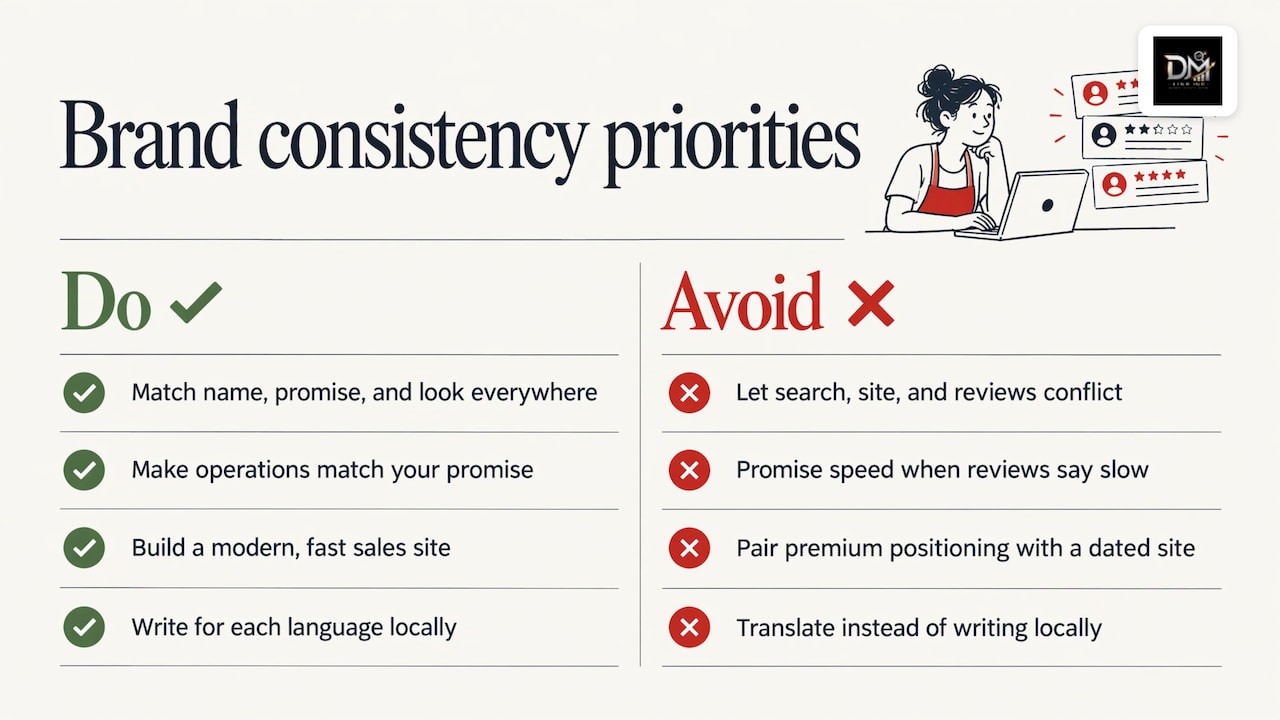
Your brand lives in search results. Before they call, most customers see your Google listing, your website and your reviews. If the name, the promise and the look match across all three, you appear established. If they conflict, you appear uncertain. This is why we treat brand and local visibility as one job. Our page on why Canadian businesses need professional branding goes deeper on that link.
Your reviews are your brand in other people’s words. What customers write about you is the closest thing to a daily test of your positioning. If you say “fast and tidy” and the reviews say “slow to answer”, the strategy has not reached operations yet. See our guides on Google review management and brand reputation monitoring for what to track and how to respond.
Your website is your main sales page. A strategy that says you are the premium choice cannot live on a site that looks dated or loads slowly. Our overview of why every Canadian small business needs a modern website explains where this goes wrong.
Language is part of the brand. In Quebec and in bilingual markets, a translated page is not the same as a page written for local customers. Brand voice should be decided in each language, not converted from one into the other. We write in English and French, written like a local.
Answer engines are a new front door. More customers now ask AI assistants and answer engines who to hire. Those systems favour businesses whose name, services and reputation are described clearly and consistently across the web. A clear brand strategy is what makes that consistency possible. We cover this in our AI and answer engine SEO service.
Worked example: a three-person plumbing company
Consider a plumbing company with three trucks. Today it competes on “fast, reliable, fair prices”, which is what every competitor says. A strategy process might find that the best-paying customers are homeowners with older houses who fear surprise costs, and that the company’s real edge is that technicians explain the problem and give a price before touching anything.
The positioning becomes: the plumber who tells you the price first. From there:
- The homepage headline, the service pages and the Google Business Profile description all say it in the same words.
- The review request message asks customers whether the price was clear before work began, which nudges reviews towards the promise.
- The truck lettering, quote forms and invoices carry the same line.
- Tone guidelines tell whoever answers the phone how to open the call.
None of that requires an advertising budget. It requires one decision, made once and used everywhere. This is an illustration of the method, not a client result.
How to tell whether your brand strategy is working
Brand effects are slower than a click, but they are not invisible. Choose a few measures before you start, record where you are today and look again after a full season.
| Signal | What to look at | What a good trend means |
|---|---|---|
| Enquiries and bookings | Calls, form submissions and booked appointments, and how many come from people who already know your name | More customers arrive ready to buy |
| Branded search | Searches that include your business name, in Google Search Console | More people are looking for you specifically |
| Review content | The words customers use in new reviews | They describe you the way your positioning does |
| Lead quality | Share of enquiries that match your target customer and your target price | The message is attracting the right people |
| Consistency | Whether your name, offer and look match across site, listings and social | Customers meet one business, not several |
Write down your baseline for each before you change anything. Then look at them quarterly. If enquiries rise but lead quality falls, the message is too broad. If branded search is flat, the brand is not travelling beyond people who already know you. Whoever runs your marketing should be able to give you these numbers in plain language.
Hiring an agency or doing it yourself
Many owners can write a first draft of their positioning, because they know their customers better than anyone. The harder parts are the outside view of your market, the discipline to make hard choices and the work of rolling the result out across a website, listings, design and content.
When you consider help, look at these points:
- Who does the work. Some agencies put an account manager between you and the people building your brand. Ask who you will actually talk to. We put you in direct contact with the team doing the work.
- One plan or several suppliers. Brand strategy, web design, search and reputation work best when they follow one plan. A single in-house team means the logo, the site and the listings are built from the same decisions.
- Ownership. You should own your domain, hosting, site, content, accounts and data from day one. That is how we operate.
- Local knowledge. Your strategy should be built on your market, your competitors and your seasons, in the language your customers use.
- Plain reporting. You should get real numbers and straight answers, not a monthly deck of vanity metrics.
If you want to see where your business is losing visibility before committing to anything, the free Leak-Proof Audit™ looks at your local authority and shows where visibility and revenue are slipping away.
Where The DM Link fits
We build local growth infrastructure for Canadian businesses: brand and logo design, website design, SEO and local search, AI and answer engine SEO, reputation and reviews, digital marketing, and custom merchandise design. The aim is that you own your visibility instead of renting it through ads, and that your brand turns into booked calls.
If you are ready to put a strategy behind your brand and have it carried through to your site, your search presence and your reputation, start with our services overview. You can also see how the pieces fit together in our Growth Package article.
The free Leak-Proof Audit™ on thedmlink.com is a practical first step if you want to know where your local authority stands before you decide anything.
Our perspective
Most small businesses do not have a branding problem. They have a consistency problem. The owner knows exactly what makes the business good, but the website says one thing, the Google listing says another, and the reviews say a third.
That is why we do not treat brand strategy as a separate project that ends with a document. We build it in-house, on one plan, so the positioning decided in the first weeks becomes the homepage, the logo, the search listings and the way you answer reviews. You talk to the people doing the work, and you own everything that gets built: domain, hosting, site, content, accounts and data.
A strategy should be written for your market, your competitors and your seasons, in the language your customers use. In Canada, that often means English and French, each written like a local. And it should be judged by plain numbers: calls, bookings and the quality of the customers who arrive.
We would rather be a partner than a vendor. That means plain language, real numbers and honest answers.
DM
FAQ
What is the difference between a brand strategy and a brand identity?
Brand strategy is the plan: who you serve, how you are different and how you want to be perceived. Brand identity is the visible and audible result: the logo, colours, typography and tone of voice. The strategy comes first so that the identity expresses a clear decision rather than a personal preference.
Does a small business really need a brand strategy?
A small business benefits because it competes with similar local options and usually has a short window to win a customer. A clear strategy makes every piece of marketing, from a homepage to a review reply, say the same thing. That consistency helps customers recognise and trust you.
What deliverables should I expect from brand strategy services?
Expect a view of your market and competitors, a positioning statement, key messages and a brand story, voice guidelines and a visual direction. A useful engagement also includes a plan for putting the brand into your website, listings, reviews and printed material.
How long does it take to see results?
Some changes, such as a clearer homepage and consistent listings, can improve enquiries soon after they go live. Brand effects such as branded search and better review language build over a few months to a season. Record your baseline before you begin so you can compare.
Can the same team handle my logo, website and search presence?
Yes. At The DM Link, brand and logo design, website design, SEO, reputation and digital marketing are handled together on one plan, so each piece reflects the same strategy.